Rifleman
Rifleman Jack Stewart: Buried Somewhere Among His Comrades at Bény-sur-Mer
Canadian
A personal reflection on the special memorial headstone of Rifleman Jack Stewart at Bény-sur-Mer Canadian War Cemetery in Normandy. Jack Stewart died on D-Day while serving with The Royal Winnipeg Rifles, but although he is known to be buried somewhere in the cemetery, his exact grave location is unknown.
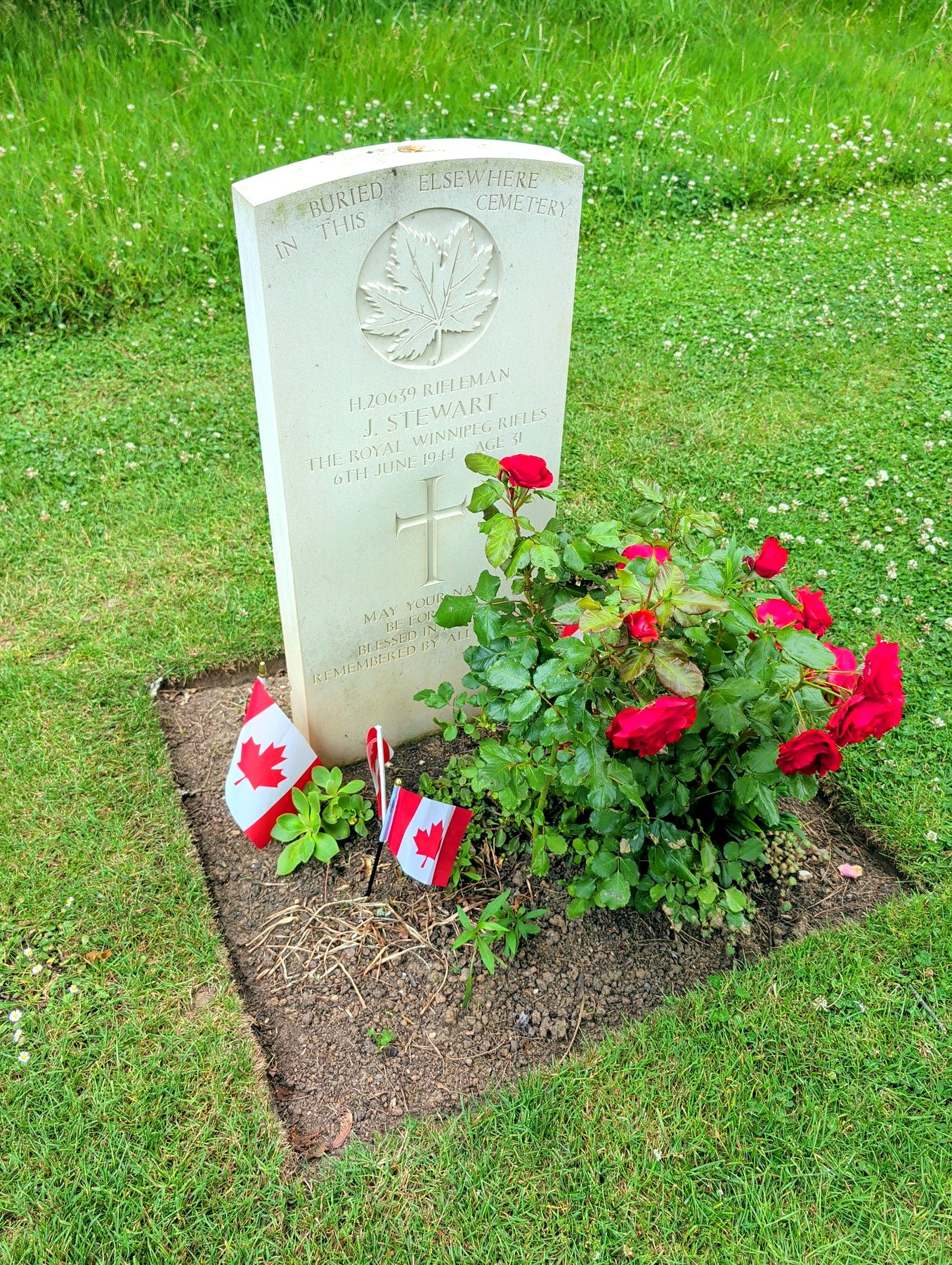
Among the quiet lawns of Bény-sur-Mer Canadian War Cemetery in Normandy, there is one headstone that really stood out to me. At first, you notice the long rows of graves, all beautifully kept and lined up with such care. It is peaceful there now. The grass is cut, the flowers are looked after, and everything feels calm and respectful. But then you notice one headstone that is slightly different from the rest.
It stands a little apart from the rows, with flowers and small Canadian flags nearby. At first glance, it looks like a normal soldier’s grave, but when you read the words carved at the top of the stone, it hits you in a different way. The words say: “Buried elsewhere in this cemetery.”
Those words stayed with me because they tell a very sad story in such a simple way. This is the special memorial headstone of Rifleman Jack Stewart of The Royal Winnipeg Rifles. His service number was H/20639. He died on 6 June 1944, on D-Day itself, and he was 31 years old. He was the son of James Green Stewart and Virginia Stewart, from Wabowden, Manitoba, Canada.
That date on the stone says enough on its own. 6 June 1944. D-Day.
For Canada, D-Day meant Juno Beach. Canadian soldiers landed in Normandy as part of the Allied invasion to begin the liberation of Europe, and The Royal Winnipeg Rifles were one of the Canadian infantry units who came ashore that morning. They landed on the Mike Red and Mike Green sectors of Juno Beach, west of the River Seulles, at around 7:49 in the morning.
It is hard to imagine what that must have been like. These men were not just landing on a beach. They were landing into fear, noise, smoke, gunfire, mines, obstacles and chaos. Their job was to get off the beach, survive, push inland, and help open the way into Normandy. Rifleman Jack Stewart died on that first day.
The most moving part of his headstone is still the inscription: “Buried elsewhere in this cemetery.” This means that Rifleman Stewart is known to be buried somewhere within Bény-sur-Mer Canadian War Cemetery, but the exact place of his grave is not known. That is why his headstone stands separately as a special memorial. His body rests somewhere in that cemetery, among his comrades, but his exact resting place could not be identified.
I found that incredibly sad. It reminds you how confusing and destructive war really is. Men were killed on beaches, in fields, on roads, in villages and in temporary battlefield burial sites. After the fighting, many were recovered and reburied properly in war cemeteries, but in some cases, even when a soldier was known to be there, the exact grave could not be confirmed.
That is what happened with Rifleman Jack Stewart, but he was not forgotten. His memorial gives him a named place. It gives his name back. It tells us who he was, who he served with, when he died, and why he should still be remembered. To me, that headstone feels almost like a quiet promise that he is here, he is known, and he is still remembered.
Bény-sur-Mer Canadian War Cemetery is actually near the village of Reviers, even though it carries the name Bény-sur-Mer. It is closely linked with the Canadian landings at Juno Beach and the hard fighting that followed inland. There are over 2,000 headstones here, and many of the men buried in this cemetery died on D-Day or during the bitter fighting in the weeks that followed.
Walking through the cemetery is a strange feeling. It is peaceful, but it is not light. Every stone has a name, a regiment, an age, and a family behind it. Some were barely more than boys. Some, like Jack Stewart, were men in their thirties with lives and families behind them. They came from towns, cities, farms and communities across Canada, crossed the ocean, and never went home.
That is what places like this do. They take the huge story of D-Day and make it personal again. We often talk about D-Day in numbers: ships, aircraft, tanks, landing craft, divisions, beaches, objectives and military plans. But standing in front of one headstone changes all of that. It stops being just a military operation and becomes one man, one family, and one life lost in Normandy.
Rifleman Jack Stewart was not just part of a military statistic. He was a son from Manitoba. He served with The Royal Winnipeg Rifles. He landed in Normandy on D-Day and died that same day. The flowers and small Canadian flags near his memorial made it even more touching, because they showed that someone had stopped there, looked at his name, and taken the time to remember him.
That matters.
Bény-sur-Mer Canadian War Cemetery is beautiful and peaceful now, but it carries the memory of what happened here. The silence makes you think, and the rows of stones make you stop. Rifleman Stewart’s memorial, standing slightly apart from the rest, says something very powerful. His exact grave may not be known, but his name is known, his sacrifice is known, and he is still remembered.
Rifleman Jack Stewart was 31 years old when he died on 6 June 1944. Somewhere in that cemetery, he rests among his comrades. He is here, he is named, and he is remembered.
Like all those who lie at Bény-sur-Mer Canadian War Cemetery, he should never be forgotten.