Article
Mondaye Abbey: A Quiet Place of Faith, History and Remembrance
A personal reflection on the Abbey of Saint-Martin de Mondaye near Bayeux in Normandy. The article explores the abbey’s peaceful atmosphere, its beautiful Chapel of the Assumption, its long religious history, and its connection to the events of D-Day and the liberation of Normandy.
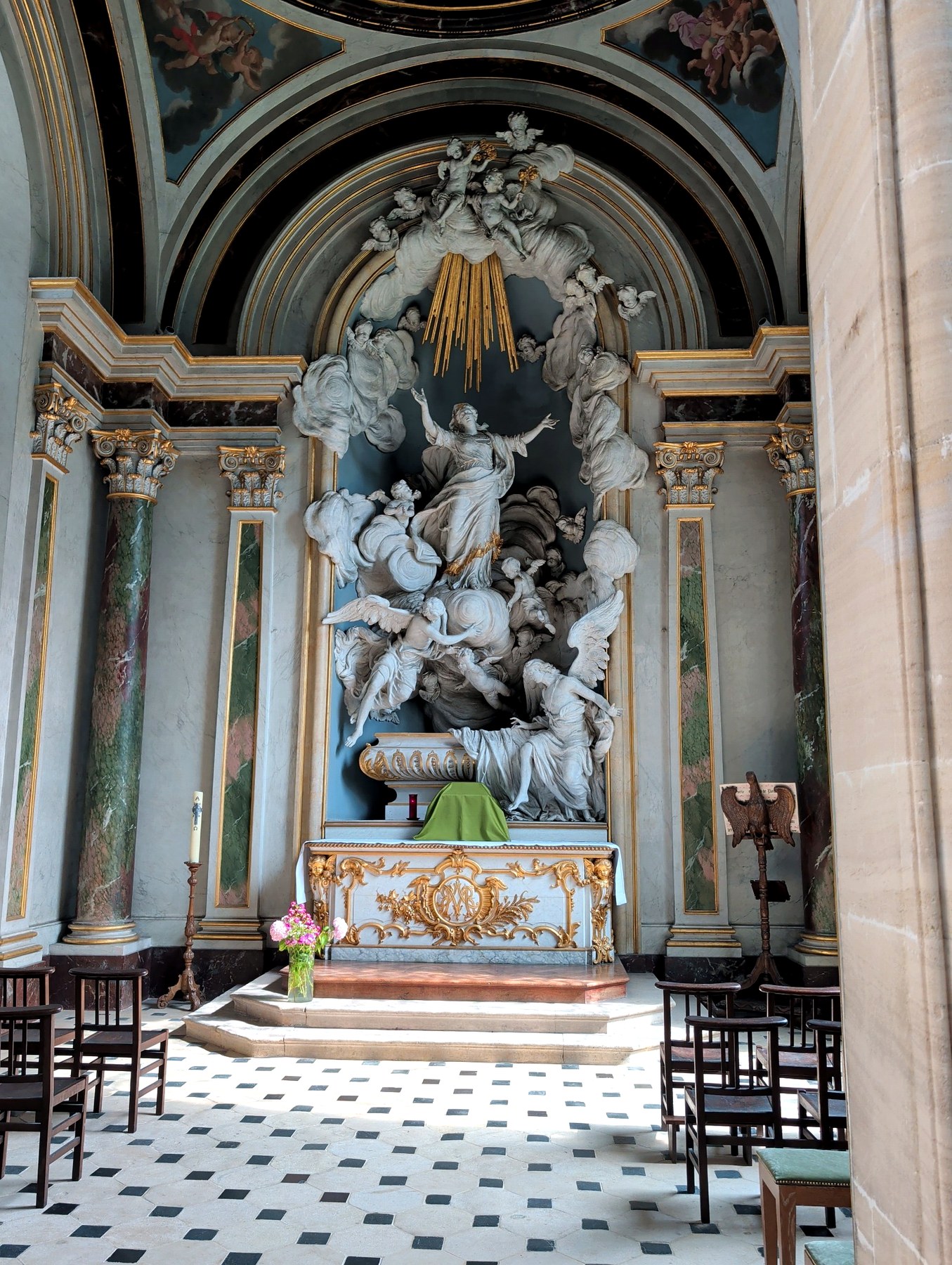
Tucked away in the quiet Normandy countryside, not far south of Bayeux, the Abbey of Saint-Martin de Mondaye is one of those places that stays with you after you leave. It is not the sort of place that shouts for attention. There are no tanks outside, no dramatic gun positions, no cliffs, and no obvious battlefield ruins. Instead, it is a place of stone, silence, prayer and history.
At first, it feels a long way from the noise and violence of the D-Day beaches. But that is one of the things I have come to realise about Normandy. The war was not only on the beaches. It reached into villages, churches, farms, abbeys, homes and ordinary communities. Mondaye Abbey may feel peaceful today, but it still carries part of that wartime story.
The abbey was founded around the year 1200 and belongs to the Premonstratensian Order, also known as the Norbertines. It is located in the Bessin countryside at Juaye-Mondaye, around nine miles south of Bayeux. What makes it feel different from some historic places is that it is still an active religious community today. It is not just an old building preserved from the past. It is still being used, still prayed in, and still alive in its own quiet way.
One of the most striking parts of the abbey is the chapel altar shown in the photograph. This is the Chapel of the Assumption of the Virgin Mary, located in the north transept. The sculptural group is a remarkable terracotta work from Noron-la-Poterie by Melchior Verly, and it really does draw your attention as soon as you see it.
Standing in front of it, the whole scene feels almost theatrical, but not in a false way. The white figures, the gold detail, the soft chapel light and the stillness of the room all come together. Your eyes are naturally drawn upwards, from the altar towards the figures above, and for a moment it is easy to forget the world outside.
For me, that was what made Mondaye Abbey so memorable. Normandy is full of military history, and rightly so, but places like this remind you that Normandy’s story is much wider than war alone. It is also spiritual, cultural and deeply human.
The abbey has lived through centuries of upheaval. Its history includes the Hundred Years’ War, the French Revolution, exile, return and restoration. Like many religious communities in France, it went through difficult times and was not always able to continue peacefully. After religious persecution in the 19th century, the community was forced away from Mondaye, before returning in 1921 and beginning the work of restoring the abbey again.
Then came the Second World War.
Because Mondaye Abbey sits close to the D-Day landing areas, it became part of the wider story of the liberation of Normandy. The abbey’s own history describes it as the first abbey in France liberated by Allied troops in 1944. Each year on 6 June, the community remembers the Allied soldiers who died during the Normandy landings.
That detail gives the place a different feeling. You are not just standing in a beautiful old abbey. You are standing somewhere that witnessed the fear and uncertainty of 1944, close to the beaches where so many young men landed to begin the liberation of Europe.
Accounts from D-Day describe bombing reaching Mondaye on 6 June 1944, with the canons, religious sisters and local refugees sheltering in the vaulted cellar of the monastery. Even in a place built for prayer, the war could not be kept outside.
That is what makes Normandy so powerful to visit. The history is not neatly contained in one place. It spreads across the whole landscape. You can be standing in a peaceful chapel, a quiet village lane, or a field beside a hedge, and suddenly realise that the war reached here too.
Mondaye Abbey is a reminder that liberation was not only a military event. It was something felt by ordinary people, by religious communities, by refugees and by families waiting in fear for the fighting to pass. Behind every map and battle plan, there were people sheltering, praying and hoping to survive.
Today, the abbey is peaceful again. Visitors come for its architecture, its art, its spiritual life and its connection to history. The church and monastery are recognised as a fine classical architectural ensemble, largely shaped in the 18th century by Eustache Restout, and the site remains protected.
For anyone visiting the D-Day sites around Bayeux, Omaha, Pegasus Bridge or Sainte-Mère-Église, Mondaye Abbey offers something slightly different. It is not a battlefield stop in the obvious sense, but it is still very much connected to the story of Normandy. It is a place to pause, look around, and think about how much this region has lived through.
The altar of the Assumption is beautiful, but for me the deeper story is the survival of the abbey itself. It was founded in the medieval world, damaged by history, affected by revolution and war, restored by those who refused to let it disappear, and then liberated in the summer of 1944.
Mondaye Abbey stands as a quiet symbol of endurance. It reminds us that remembrance does not always have to be loud. Sometimes it is found in silence, in a chapel, in old stone, in a candle, and in peaceful places where war once reached.